Glass vs Stainless Steel French Press: Which One Should You Actually Buy?
You have narrowed it down to a French press. Now you are stuck on the next question: glass or stainless steel?
I will save you some time. The coffee tastes the same. Good borosilicate glass and good stainless steel are both neutral. Nothing about the body of the press changes the flavor in your cup.
What does change is how hot your coffee stays, whether the press survives your kitchen, what it weighs, and what you pay. So the real question is: how do you drink your coffee, and how careful are you?

The quick answer
- Get glass if you pour the whole pot right away, you like watching it brew, and you want to spend under $45.
- Get steel if you sip slowly, you have broken a glass press before, or it is going camping, to the office or into a house with kids.
Head to head
| Borosilicate glass | Double-wall stainless steel | |
|---|---|---|
| Typical price (34 oz) | $20 to $45 | $30 to $55 budget, $100+ premium |
| Heat retention | Cools fairly fast | Much longer (premium models) |
| Durability | Can crack or shatter | Dents at worst |
| Watch the brew | Yes | No |
| Flavor | Neutral | Neutral |
| Weight empty | Usually lighter | Usually heavier |
| Spot a dirty press | Easy, you can see the film | Harder, oils hide inside |
| Best pick | Bodum Chambord | Frieling (premium), Mueller (budget) |
Heat: the biggest real difference
Single-wall glass lets heat walk right out through the sides. During a four-minute steep, that barely matters. But if you like to leave the rest in the press for a second cup, a glass press will hand you lukewarm coffee 20 minutes later.
Double-wall steel traps a layer of air between two walls, which slows that heat loss a lot. Frieling says its press keeps coffee hot up to four times longer than glass.
But here is the catch, and it is a big one: coffee that sits on the grounds keeps extracting, even after you plunge. That is what turns your second cup bitter. So even with a steel press, the best move is usually to pour the coffee off into a mug or thermal carafe. Our steep time guide explains why.
Also, not every steel press insulates the same. The budget Mueller gets mixed reviews on heat. Some owners are happy, others say it cools fast. If heat is your whole reason for buying steel, that is where spending more makes a difference.
Durability: what breakage really costs you
Glass presses almost always die the same way. You knock the beaker against the faucet while rinsing it, or it slides off a wet counter.
The good news: Bodum sells replacement beakers, so one accident does not mean a whole new press. The bad news: replacement glass is not free, and if it happens once a year, you are basically paying for a steel press in installments.
Here is how I would think about it. Broken zero glass presses in your life? Glass is fine. Broken one? Keep a spare beaker. Broken two or more, or you have kids? Just buy steel and stop worrying. Our shatterproof French press picks cover the toughest ones.
Weight and handling
Steel presses usually weigh more empty. But once you fill them, the water is the heavy part. A full 34 oz press carries about two pounds of water no matter what it is made of.
If lifting and pouring is getting hard on your hands or wrists, a light glass press like the Bodum Brazil, or a smaller 17 oz steel press, is easier. More on that in the best French presses for arthritis.
Taste: the myth
You will see people swear steel makes coffee taste metallic or glass makes it taste purer. In a good press, neither is true. What really changes the taste in a French press is the filter and your grind. A finer filter means less grit and a cleaner cup. A coarse, even grind means less bitterness. See French Press Filters Explained.
What about plastic?
Plastic presses are light, cheap and basically unbreakable, which is why they are popular for backpacking. The downside: some plastics stain and hold onto old coffee smells over time. Fine for the campsite, not my pick for the kitchen counter.
The best glass press: Bodum Chambord
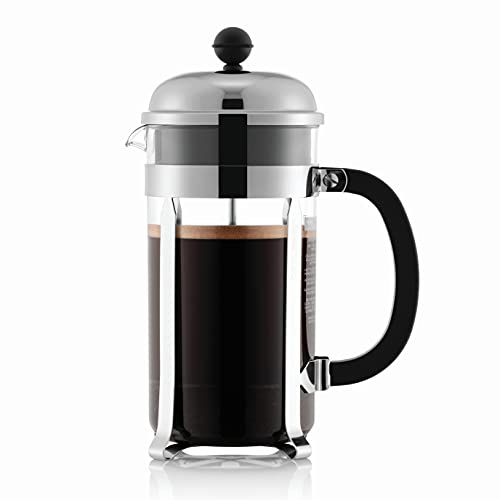
Bodum 1928-16US4 Chambord French Press Coffee Maker, 1 Liter, 34 Ounce, Chrome
- Check specifications and compatibility before purchasing.
As an Amazon Associate, we may earn a small commission from qualifying purchases.
If you go glass, I would go Chambord. It is usually $30 to $45 for the 34 oz, Bodum sells every spare part, and the steel frame makes it sturdier than the cheaper Brazil. It brews exactly the same coffee as presses that cost three times more.
Bodum Chambord French Press — Pros & Cons
The classic glass press, and still the benchmark everything else gets compared to.
Pros
- Great coffee for the money Usually about $30 to $45 for the 34 oz size. The brew is the same as presses costing far more.
- Spare parts everywhere Replacement beakers and filters are cheap and easy to find, so one accident does not mean a new press.
- Steel frame, not plastic The polished frame and handle feel more solid than the budget Bodum Brazil and hold up for years.
- Lots of sizes From 12 oz up to 51 oz, so you can match it to your household.
Cons
- Glass can break A knock on the faucet is the most common way these presses die.
- Coffee cools quickly Single-wall glass, so pour it all off once the steep is done.
- Some sludge Reviewers comparing it with an Espro see visibly more sediment in the cup.
For most people buying their first French press, this is the answer. It makes the same coffee as presses that cost three times more, you can watch it brew, and Bodum sells every spare part. The only real downsides are glass that can break and coffee that cools fast.
The best steel press: Frieling Double-Walled
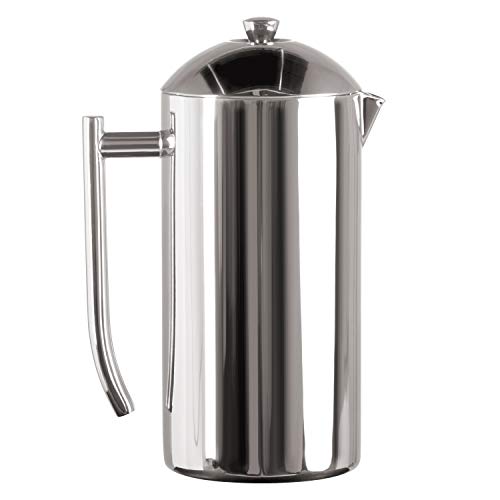
Frieling Double-Walled Stainless-Steel French Press Coffee Maker, Polished, 17 Ounces
- Ultimate Coffee Experience: Delight in an exceptional coffee experience with the Frieling French Press Coffee Maker. Its Zero Sediment Dual Screen ensures a smooth, sediment-free brew, making it a superior choice among metal French presses
- Superior Heat Retention: Featuring a dual-wall stainless steel design, this insulated French Press maintains optimal temperatures longer than a glass French press. Ideal for daily use and as a camping coffee maker, its sturdy construction is perfect for any adventure
- Award-Winning Excellence: Esteemed by leading magazines and coffee aficionados, the Frieling French Press Coffee Maker is a preferred choice in luxury hotels. This stainless steel coffee maker consistently delivers a flavorful, full-bodied brew
- Effortless Brewing Guide: For an ideal brew, add two tablespoons of ground coffee per cup of water into your stainless steel coffee pot. Pour slightly cooled boiling water, stir, brew for four minutes, then press the plunger slowly for delicious French coffee press results
- Commitment to Quality: Since 1988, Frieling has been known for well-crafted products like this all stainless steel coffee maker. Our mission is to provide innovative solutions for daily challenges, ensuring each product is a valuable addition to your life
- Versatile Use: This 17 Oz polished stainless steel French Press is perfect for everyday use, camping, and travel. With a reusable filter and manual operation, it serves as a reliable non-plastic coffee maker for all your coffee and tea adventures
As an Amazon Associate, we may earn a small commission from qualifying purchases.
If you go steel and you care about heat, I would go Frieling. Double-wall 18/10 steel, a dual-screen filter for less grit, fully dishwasher safe, and retailers list a 5-year limited warranty. It is about $100 for 17 oz, so it is a real investment. It only makes sense if you brew most days.
Frieling Double-Walled Stainless French Press — Pros & Cons
A premium steel press that is built to last for years.
Pros
- Really keeps coffee hot Frieling claims up to four times longer than glass, and it is the part owners praise most.
- Dual-screen filter A pre-filter plus a fine screen catches grit that gets past a basic Bodum screen.
- 5-year limited warranty Retailers list a 5-year manufacturer warranty, which is rare for a French press.
- Fully dishwasher safe The whole press can go in the dishwasher.
Cons
- Pricey for the size About $100 for 17 oz. A Bodum Chambord holds twice as much for well under half the price.
- No view of the brew You time it instead of watching the color.
- Small for families 17 oz is about two mugs. Bigger Frieling sizes cost even more.
You are paying about $100 for a 17 oz press, which is a lot. What you get is polished 18/10 steel, a dual-screen filter, real insulation and a 5-year limited warranty. If you drink French press every day and are tired of replacing glass, it pays for itself. If you only brew on weekends, buy a Bodum.
The budget steel option: Mueller
Want steel for toughness, not heat? The Mueller is about $30 to $55, will not break and goes in the dishwasher. Just do not buy it expecting Frieling-level insulation. I compare all three steel presses in the best stainless steel French presses.
The bottom line
If you drink your coffee right away and you are reasonably careful, glass is the better value. Put the money you save toward a burr grinder and you will taste a bigger difference than any press upgrade.
If you sip slowly, you are hard on your stuff, or you have already swept up a broken beaker, spend the extra on steel. You will stop thinking about your press, and that is worth something.
Still choosing size and filter too? Here is the full checklist: How to Choose a French Press.
FAQ
Does a stainless steel French press make coffee taste metallic?
Not a good one. Food-grade stainless steel is neutral. A metallic taste usually means old oils need cleaning out.
Is a glass French press safe with boiling water?
Borosilicate glass is made to handle hot water. Just avoid sudden temperature shocks like pouring cold water into a hot beaker.
Which keeps coffee hotter, glass or steel?
Double-wall steel, by a lot. Single-wall steel is not much better than glass.
Which is easier to clean?
About the same. Glass makes it easier to see when it needs a deep clean.