Should You Add Salt When Brewing Coffee?
Should you add salt to coffee? It’s optional, not a standard requirement for brewing a good cup. Research shows sodium can reduce the perceived bitterness of some bitter substances, but it does not make poorly brewed coffee automatically taste better or remove coffee’s acids. See the published sensory study.
Whether salt helps a particular cup is a matter of taste. If the coffee tastes harsh or bitter, review the grind size and extraction, coffee-to-water ratio, brewing water temperature and beans before adding anything.
Sodium can suppress the perception of certain bitter tastes, which may make other flavors more noticeable. It does not add sugar or sweetness, and reducing perceived bitterness is different from changing the coffee’s acidity or pH. For more on the flavor distinction, see our acidic versus bitter coffee guide.
This guide examines the flavor claim, its limitations, and why balancing extraction may be a better first step than adding ingredients to coffee. Anyone who has been advised to limit dietary sodium should account for that too.
What Salt Can and Cannot Change in Coffee
The claim about salt and bitterness has a basis in sensory research, but the extent of any taste change depends on the beverage and the person tasting it.
Studies of taste perception offer a more useful explanation than claiming universally better results: sodium can reduce the perceived intensity of some bitter compounds, not every unwanted flavor.
Salt can suppress the perceived intensity of some bitter compounds, which may make a coffee taste less harsh. This is a sensory effect, not proof that sodium creates sweetness or makes every coffee taste better. Adjusting an overly extracted brew is often more effective than adding salt.
Salt should not be described as neutralizing the acids in coffee. It can change how a cup tastes, but perceived sourness, measured pH, and digestive tolerance are different questions. If a brew tastes sharply sour, review the recipe and extraction rather than assuming salt will change its acidity.
Salt is an optional flavor experiment, not a reliable upgrade for every cup. Sensory studies suggest sodium can reduce the intensity of some bitter tastes, but the effect varies with the coffee and the amount used.
A small amount may change perceived bitterness for some people, while more can make the cup taste noticeably salty. There is no scientifically established universal amount that improves all coffees.
Changes the perception of bitterness: When salt suppresses some bitter sensations, other flavors may become more noticeable. That is not the same as adding sweetness or increasing sugar content.
May reduce perceived harshness: A change in bitterness is possible, but it is not guaranteed and does not mean the brewed coffee contains fewer bitter compounds.
Does not create flavor compounds: Salt may alter flavor balance for some tasters. It does not bring out every subtle note or replace fresh beans and a consistent recipe.
Results depend on the brew: Bean variety, roast, grind and extraction affect cup balance. Adjust those variables first when bitterness is caused by brewing choices.
Does not neutralize acidity: Changes to perceived bitterness do not establish a reduction in coffee’s measured acidity.
Flavor depends on preference: Any taste difference is subjective; salt is not a remedy for acid sensitivity or stomach discomfort.
An optional ingredient, not an essential technique: Salt may change how a coffee tastes, but a good cup does not require it.
Not suitable for every routine: Taste preferences differ, and people advised to reduce sodium should consider that advice before adding salt to beverages.
No special equipment required: The more important factors remain consistent coffee measurement, appropriate grinding and a repeatable brewing method.
Evaluate flavor changes individually: If you try salt, compare the result against the same coffee without added salt; do not assume that a different taste is automatically better.
Does Coffee Naturally Contain Sodium?
Coffee naturally contains trace minerals, including sodium, but it is not normally considered a significant source of dietary salt. The sodium content of a brewed cup depends partly on the water used and any ingredients added afterward.
The amount of salt in coffee beans can vary depending on where and how the beans are grown and processed. Typically, the amount of salt in coffee beans is not enough to affect the taste of the coffee noticeably, but it can have a negligible impact on the overall flavor.
Water mineral content matters for brewing flavor, but water hardness mainly refers to calcium and magnesium, not sodium. Some municipal supplies and water treatment systems can contain or add sodium, so consult a local water report when this matters.
Filtering does not automatically remove sodium: different filters remove different dissolved minerals. For people monitoring sodium intake, the composition of their drinking water and any added ingredients are more useful than assuming all filtered water is sodium-free.
Conventional ion-exchange water softeners may replace calcium and magnesium with sodium, so installing a softener is not a reliable way to reduce sodium in brewed coffee. Select drinking water based on a verified mineral analysis.

Should You Add Salt To Coffee?
Whether or not you should add salt to your coffee is a matter of personal preference. While some coffee enthusiasts swear by the technique, others may find that it changes their coffee taste in a way they don’t enjoy.
Any taste benefit is subjective. Salt may suppress some bitterness in a particular cup, but it cannot rescue every brewing flaw, and it does not chemically neutralize coffee acids.
If experimenting, do not assume more salt is better: too much can overpower coffee, and a different taste does not mean brewing problems have been fixed. Anyone limiting dietary sodium should account for salt added to drinks.
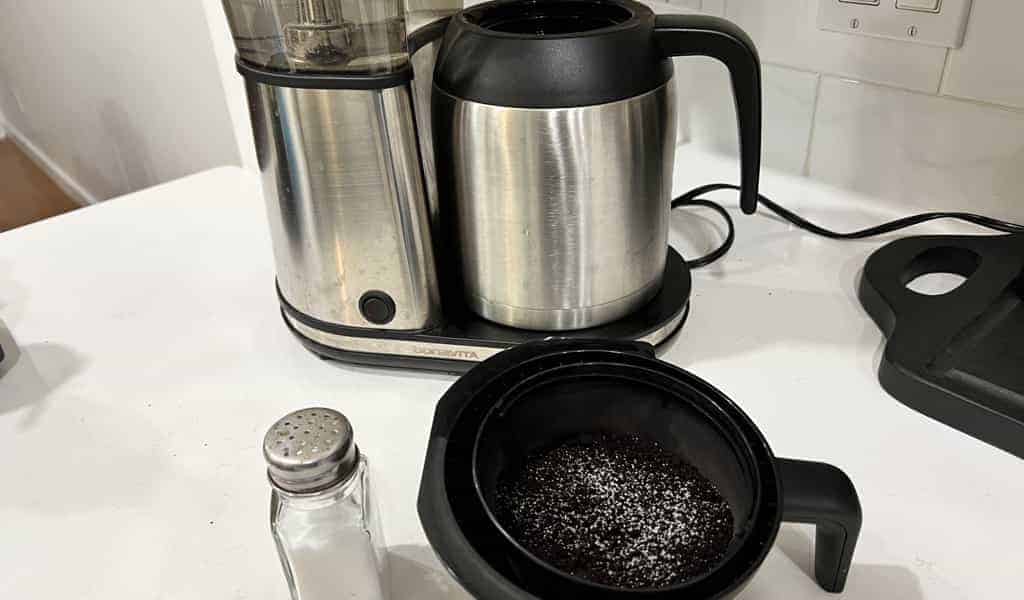
I have tried adding a pinch of salt to coffee grounds before brewing, but that does not guarantee a balanced cup. Another option is to taste the coffee first, then compare a small test portion with an unsalted portion. The result is a matter of personal preference.
The difference may be noticeable in some coffees and negligible in others. When bitterness comes from the brew itself, adjusting grind size, ratio, or extraction is usually a better first step.

What Type of Salt Should You Use?
No specialty salt is necessary for this experiment. Table salt, kosher salt, sea salt, and Himalayan salt all contain sodium chloride. Crystal size can affect how consistently a small amount is measured, so keep the quantity and brewing recipe consistent when comparing results.
Ordinary food-grade table salt can dissolve readily in coffee. The presence of anti-caking agents does not make it categorically unsuitable for a hot beverage; any detectable flavor change depends on amount and personal perception.
Kosher salt is often coarser than table salt, but crystal size and density vary by brand. A pinch or teaspoon of kosher salt is not necessarily equivalent to the same volume of fine table salt, so avoid treating them as interchangeable measures.
Sea salt is produced by evaporating seawater and is sold in both fine and coarse forms. Processing and crystal size vary, so the label alone does not tell you how much salt a pinch contains or whether it will taste better in coffee.
Pink Himalayan salt is one type of rock salt. Its pink color comes from trace minerals, but it does not offer a demonstrated advantage over ordinary salt for reducing bitterness in coffee.
Specialty labels do not make salt inherently better suited to coffee. For a fair comparison, use the same brewed coffee for the salted and unsalted samples, and remember that coarse and fine crystals are not equivalent when measured by volume.
Iodized salt is also edible and can be used in cooking or drinks. There is no reliable reason to assume that its iodine content always creates an unpleasant taste in coffee.

How Much Salt Should You Add?
There is no established amount of added salt that guarantees an improved cup of coffee. Dietary sodium is also relevant for people with sodium restrictions, so this is best treated as a discussion of flavor perception rather than a standard brewing recommendation.
There is no consistent evidence-based rule that light roast requires less salt than dark roast. Beans, brewing method and personal taste affect the result, and many people prefer not to add salt at all.
It’s always best to start with a small amount of salt and then adjust as needed. It’s easy to add more salt, but it’s difficult to remove it once it’s been added. It’s also important to note that too much salt can overpower the taste of the coffee, and it’s a good idea to taste it before and after adding it.

Methods of Adding Salt to Coffee
There are two main methods of adding salt to coffee: adding salt to the coffee grounds before brewing, or adding salt to the brewed coffee.
Add Salt to Coffee Grounds before Brewing
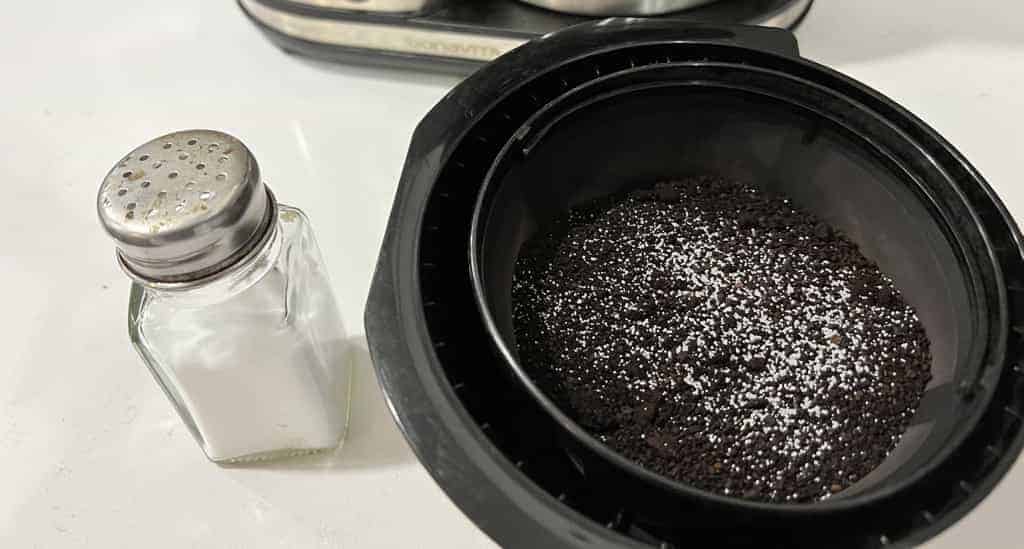
This method involves adding a pinch of salt (about 0.12 grams) to the coffee grounds before brewing. The salt will infuse with the coffee as it brews, creating a well-balanced cup with a smooth and rich taste.
This method is ideal for those who like a constant salt infusion throughout the brew. Additionally, it’s relatively easy to measure and control the amount of salt you add to the coffee grounds.
One benefit of this method is that it allows for a more consistent salt infusion throughout the brew. This means that every sip of your coffee will have the same level of saltiness, providing a more consistent and enjoyable experience. Additionally, it eliminates the need to add salt to brewed coffee, which can be more convenient for some people.
Add Salt to Brewed Coffee
This approach adds salt to brewed coffee rather than the grounds, allowing the flavor to be assessed before any change. It also avoids altering the entire batch when only one person wants to experiment.
This method is ideal for those who like to adjust the amount of salt in their cup. It allows you to control the level of saltiness so that you can add more or less salt depending on your taste preferences.
Additionally, it eliminates the need to measure and add salt to the coffee grounds before brewing, which can be more convenient for some people.
One of the downsides of this method is that it may need to be more consistent, as the level of saltiness can vary depending on how much salt you add to each cup, but it can be adjusted to your preference.
Pros & Cons of Adding Salt to Coffee
Adding salt to coffee is a technique that can have a big impact on the flavor of your coffee, but it’s only for some. Here are some of the pros and cons of adding salt to coffee:
Pros
Enhances the natural sweetness of the coffee: Salt can bring out the natural sweetness of the coffee beans, making for a less bitter and more enjoyable coffee.
Reduces bitterness: Salt can reduce the bitterness in coffee, making for a smoother and more balanced cup.
Brings out the complex flavor profiles of the coffee beans: Salt can help to enhance the flavor profiles of coffee beans, allowing the unique and subtle flavors to shine through.
Creates a well-balanced cup of coffee with a smooth and rich taste: The combination of sweetness, reduced bitterness, and enhanced flavor profiles create a cup of coffee that is well-balanced, smooth, and rich.
Does not neutralize acidity: Taste perception and actual acidity are separate considerations.
Cons
Only for some: Some people may not enjoy the taste of salt in their coffee.
Can overpower the taste of the coffee: Too much salt can overpower the taste, making it difficult to remove once it’s been added.
Can be difficult to measure: It can be challenging to measure and control the amount of salt you add to your coffee, which can affect the taste.
Can be inconvenient for some people: Adding salt to the coffee grounds before brewing can be inconvenient, as it requires an extra step in the brewing process.
Salt can change the perception of bitterness in some coffees, but it does not reliably improve every brew or neutralize its acidity. Consider flavor preferences and sodium intake, and start by adjusting the extraction variables if the coffee tastes overly bitter or sour.

Does Salt Make Coffee Less Bitter?
Some sensory studies suggest that sodium can suppress the perception of bitterness, but this does not mean it removes or chemically neutralizes bitter compounds in brewed coffee.
Some people perceive less bitterness after adding salt, which may allow other existing flavors to stand out. That effect varies and does not mean salt creates new flavor compounds in coffee.
Reducing perceived bitterness is one form of taste masking: sodium can influence how strongly some bitter substances register. It does not chemically remove the bitter compounds themselves.
There is limited support for the idea that sodium can suppress some bitter tastes, not for the claim that salt consistently makes brewed coffee sweeter or better. The simplest way to improve an overly harsh cup may be to adjust brewing variables.
Frequently Asked Questions
Does the Navy put salt in coffee?
Stories about sailors putting salt in coffee circulate, but it is not accurate to present this as a universal Navy policy. Adding salt does not make coffee hydrating in a special way; sodium may affect perceived bitterness.
What are the methods of adding salt to coffee?
There are two main methods of adding salt to coffee: adding salt to the coffee grounds before brewing, or adding salt to the brewed coffee.
How much salt should I add to my coffee?
There is no standard amount of salt proven to improve coffee, and none is required for brewing. People who monitor sodium intake should take added salt into account.
Final Thoughts: Should You Add Salt When Brewing Coffee?
In conclusion, the effects of salt on perceived bitterness are real in some sensory tests but are not a guarantee of better coffee. The flavor outcome is subjective, and salt does not substitute for proper brewing or reduce the acidity of the beverage.
Some coffee drinkers discuss this technique, but popularity alone is not evidence that it reliably improves the taste. Treat it as an optional flavor experiment rather than a standard recommendation.
No specific roast, coffee quality or water condition has been shown to require added salt. If coffee tastes harsh or flat, begin by checking bean freshness, water quality and extraction before considering flavor additions.
Whether the change is pleasant depends on personal taste. There is no need to add salt to make a flavorful cup of coffee, particularly when adjusting the grind, ratio or brewing time can solve the problem.
Salt is not necessary for a balanced cup of coffee. If bitterness is unpleasant, first review extraction, water temperature and roast choice. For troubleshooting these factors, read our acidic versus bitter coffee guide and grind-size explainer.