How to Brew Coffee for a Crowd: Amounts and Equipment
The easiest way to make coffee for a group is to plan serving volume, measure coffee by weight, and brew in repeatable batches. Use a familiar drip brewer or large pour-over, confirm the machine’s true water capacity, and keep finished coffee in a clean, prewarmed insulated carafe rather than leaving it on a hot plate for hours. Offer a decaf or non-coffee option when appropriate.
How much coffee should you make for a group?
Start by estimating about 200–240 ml of finished coffee per person for a modest mug, then consider whether guests may want a refill. This is a planning estimate, not a required serving size. A machine’s labelled “cup” often means a smaller measurement than a household mug, so measure the actual pitcher or reservoir instead of trusting the number printed on a box.
| Guests | Example finished coffee at 200 ml each | Planning suggestion |
|---|---|---|
| 4 | 800 ml | One batch in a suitable brewer |
| 8 | 1.6 L | Two smaller batches or one large-capacity batch |
| 12 | 2.4 L | Several repeatable batches; allow extra for absorption |
| 20 | 4.0 L | Use an appropriately sized urn or multiple brewers |
Remember that dry coffee holds back some liquid during brewing, so the water you pour into a brewer will usually be greater than the coffee you serve. If you need a precise amount for an event, make a trial batch and measure its output.
What coffee-to-water ratio works for batch brewing?
For standard filter coffee, about 55–60 g of ground coffee per 1,000 g (1 L) of brewing water is a reasonable starting range, adjusted for the brewer and your guests’ taste. The Specialty Coffee Association’s certified-home-brewer test specifications use 55 g/L in their procedure; that is a technical testing reference, not an instruction that every recipe must taste identical. See the SCA home brewer program and our coffee-to-water ratio guide.
| Brew water | Ground coffee (55 g/L) | Ground coffee (60 g/L) |
|---|---|---|
| 500 ml | 27.5 g | 30 g |
| 1 L | 55 g | 60 g |
| 1.5 L | 82.5 g | 90 g |
| 2 L | 110 g | 120 g |
The coffee weights scale from the brewing-water amount, not the number of people. Divide larger volumes into batches that fit the maker’s stated capacity and filter size. Do not overload a basket simply to brew more at once.
Choose the right brewing setup
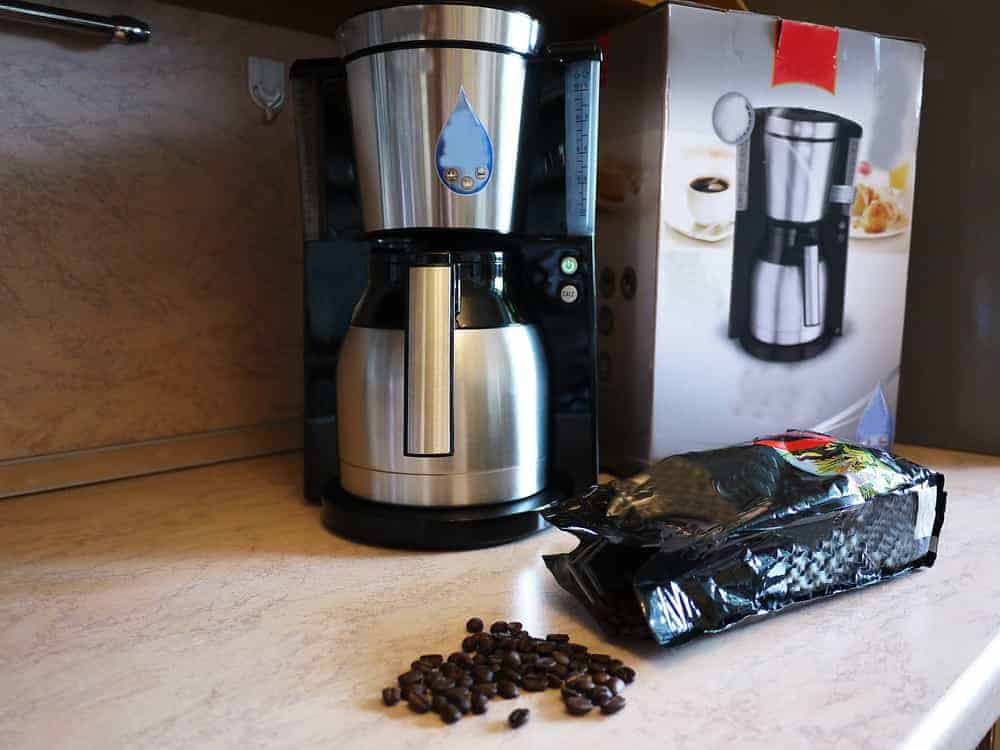
Standard automatic drip brewer
This is often the simplest option for a home gathering: measure the dose and reservoir water, insert the correct filter, then allow the full brew cycle to finish. Use the appliance’s instructions for safe fill levels, carafe placement and heating. Our drip coffee-maker comparison explains relevant capacity and carafe differences.
Large pour-over or manual brewing
Pour-over makes sense for a smaller group if you enjoy manual control, but a very large coffee bed may not drain like a smaller one. Use the dripper’s rated capacity and repeat your proven recipe in multiple batches rather than assuming that doubling every number will reproduce the identical taste. Our pour-over brewer guide explains some equipment differences.
Coffee urn or commercial batch brewer
For a bigger event, a device designed for group service may simplify volume and temperature management. Follow its minimum and maximum batch instructions. Avoid buying or borrowing equipment that has not been cleaned or operated in accordance with its manual.
Six steps for stress-free group brewing
- Ask what people prefer. Allow for those who would rather have decaf, tea or another beverage.
- Estimate finished volume. Decide whether the group is likely to want small cups or refills, then add a reasonable buffer.
- Check brewer capacity. The rated “cup” number may not match your guests’ mug sizes. Measure the reservoir or use its litre markings.
- Weigh the grounds. Aim for a consistent dose across batches so the first and last pots taste similar.
- Brew before serving. Start close enough to the event that the coffee can be served fresh, but allow enough time for the machine to complete its normal cycle.
- Transfer to a clean insulated carafe. Prewarm it according to its manufacturer’s instructions and keep lids closed between pours to reduce heat loss.
Keeping batch coffee warm without ruining it
Repeated heating can dull aromas and change the perceived taste. A thermal carafe holds temperature without continuing to cook the drink, though it cannot keep coffee warm indefinitely. Wash the carafe thoroughly before use; old coffee oils are noticeable when serving an otherwise fresh batch.
If coffee is left for an extended period, taste and replace it rather than topping a stale pot with fresh coffee. For any milk or cream served alongside, follow appropriate refrigeration and food-handling requirements.
Common mistakes when brewing for a crowd
- Using the “12-cup” label as twelve full mugs: Maker cup markings often use smaller sizes. Convert to millilitres.
- Increasing the dose without checking basket space: Overfilled filters can overflow or extract unevenly.
- Pre-grinding far ahead: Coffee aroma changes over time. Weigh and grind closer to brewing when practical.
- Mixing inconsistent batches: Note the grams of water and coffee used for each pot, then repeat a recipe you like.
- Ignoring cleanup: Coffee residue from a carafe or brewer can alter flavor. Clean the equipment in advance.
Example: coffee for 12 guests
At 200 ml per guest, the target is roughly 2.4 L of finished coffee. A brewer that accepts 1 L of water will deliver less than 1 L into the carafe, so three batches of roughly 1 L each may be a sensible initial plan, with the exact yield measured and adjusted. At 55–60 g coffee per litre of water, each batch uses 55–60 g grounds. Have extra clean water and coffee ready, rather than trying to fill a small machine beyond its safe capacity.
Bottom line
Plan in actual millilitres, use a simple weighed ratio, respect brewer capacity, and store freshly brewed coffee in insulated equipment. Consistency and hospitality matter more than buying the largest possible machine.
Sources: Specialty Coffee Association Certified Home Brewer program; National Coffee Association drip-coffee guidance. Group serving sizes above are planning estimates, not SCA standards.